Circuit Sud Tadrart Rouge

Terres Touareg

The red desert of Algeria: the Tadrart, jewel of the Sahara

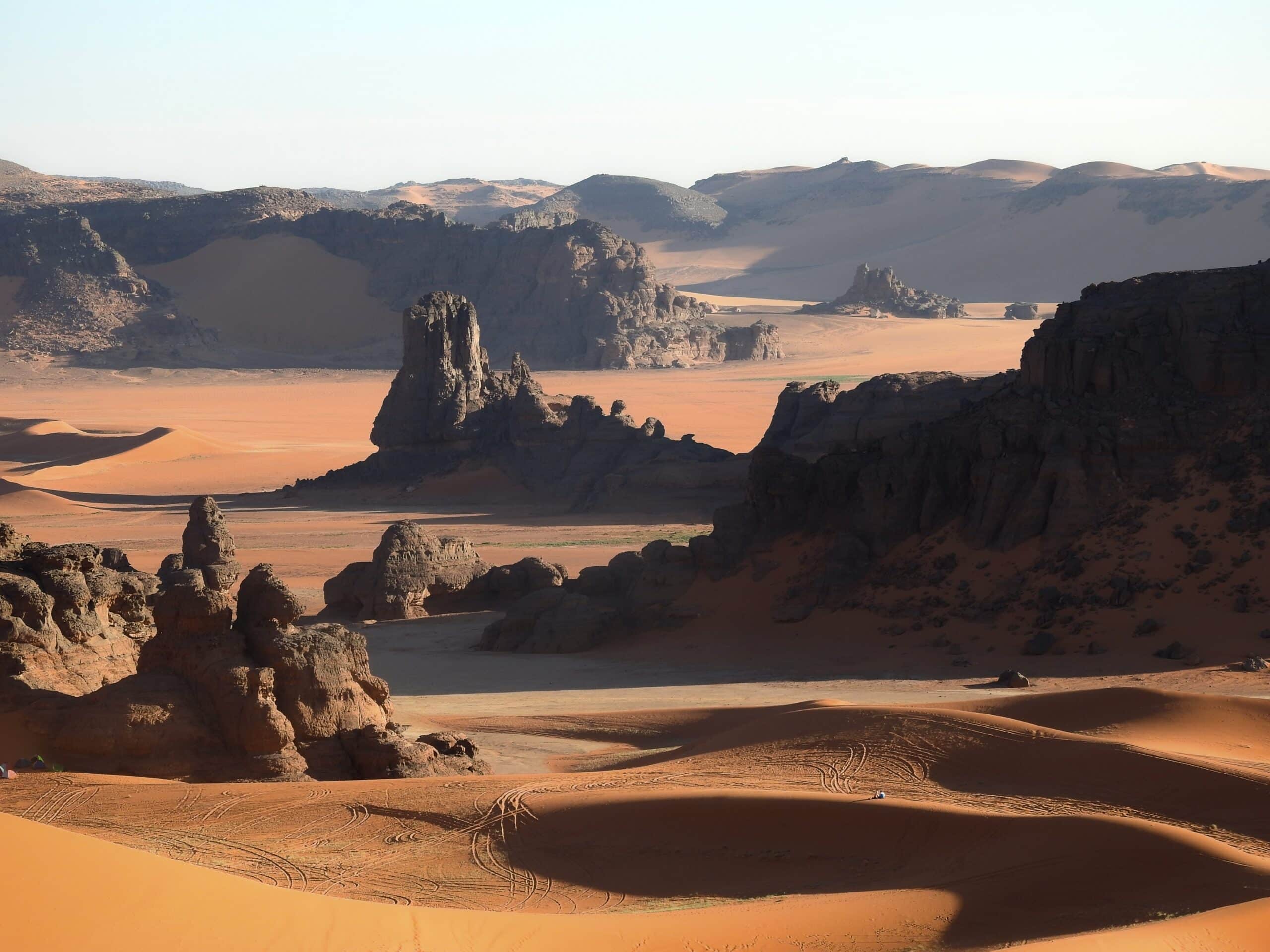
In the far south-east of Algeria, the Sahara reveals a region with landscapes marked by colour and relief: a series of red and orange dunes stretching as far as the eye can see, punctuated by rock formations sculpted by the wind. This red desert of Algeria, called Tadrart, is distinguished by the intensity of its colours and the diversity of its landscapes. Depending on the time of day, the light transforms the shades of the sand and accentuates the contrasts between the dunes and rock formations, offering a particularly striking natural setting.

Located at the gateway to Djanet, in the heart of the Tassili n’Ajjer massif, Tadrart embodies one of the most beautiful Saharan experiences in the country. A journey out of time, in the heart of a desert of striking beauty.

Where is the red desert in Algeria?

The red desert of Algeria, known as the Red Tadrart, is located in the far south-east of the country, near the Libyan border.

The Tadrart is part of the vast Tassili n’Ajjer region, listed as a UNESCO World Heritage Site for its landscapes and thousands of prehistoric rock carvings.

The main access point is the town of Djanet, the gateway to the eastern Algerian Sahara. From Djanet, it takes several hours by 4×4 to reach the first red dunes.

Geographically, the Tadrart differs from the Tassili plateau in its more rugged terrain and vast red sand ergs (fields of dunes). It is this combination of dunes and rock formations that gives it its unique identity.

Why is Tadrart the most beautiful red desert in Algeria?

Red dunes sculpted by the wind

The red colour of the sand comes from its high concentration of iron oxide. In the low light of morning or evening, the dunes take on flamboyant hues.

The wind shapes the sand into fine ridges, elegant waves or vast, perfect curves. Each storm redraws the landscape. No landscape is fixed.

The highest and best-known dune in the red desert is Tin Merzouga, rising to over 1,300 metres, making it one of the highest dunes in Algeria.

Climbing this dune offers a spectacular 360° panoramic view of the horizon.

Spectacular mineral landscapes

But the Tadrart is not just a sea of dunes. There are also natural arches that rise up before your eyes, including the ‘Cathedral of Tamezguida’. This part of the desert is also home to rocky peaks, canyons and formations with astonishing shapes. Some landscapes evoke a lunar or Martian setting.

The contrasts between the red sand and dark rock create exceptional visual depth.

A thousand-year-old rock art heritage

The Tassili n’Ajjer massif, a cultural park listed as a World Heritage Site, is home to one of the richest collections of rock art in the world. The engravings and paintings bear witness to a time when the Sahara was green.

Observing these works, which are thousands of years old, in the heart of Algeria’s red desert gives the journey an almost spiritual dimension.

What to do in Algeria’s red desert, the Tadrart?

Hiking and trekking in the dunes

The Tadrart is mainly explored on foot or by 4×4. Treks allow you to walk at the pace of the desert, to feel the silence and immensity.

Itineraries vary from a few days to over a week, depending on your level and the time available.

Camping under the stars

Spending the night in Algeria’s red desert is an unforgettable experience. The sky, completely free of light pollution, reveals a starry canopy of exceptional clarity.

Camps are usually organised with local Tuareg teams, who set up the camp and prepare meals.

Photography and contemplation

The Tadrart is a paradise for photographers. The play of shadows on the dunes, the silhouettes on the ridges, the flamboyant sunsets… every moment offers a natural tableau.

But beyond photography, it is a place for contemplation. A space to slow down.

Immersion in Tuareg culture

Travelling through Algeria’s red desert also means discovering Tuareg culture. The guides share their knowledge of the territory, their traditions and their intimate relationship with the desert.

This human encounter gives the experience its full meaning.
FAQ: everything you need to know about Algeria’s red desert

Is Algeria’s red desert dangerous?

No, not when visiting with an approved agency and local guides.

What is the difference between Tadrart and Tassili?

Tadrart is a specific region within the Tassili n’Ajjer massif, characterised by its red dunes.

How many days should I plan for?

Ideally 6 to 8 days for a complete immersion.

Can I travel alone?

No, access is regulated and requires a guide.

What is the temperature in the Red Desert?

Between 18 and 25°C during the day and between 5 and 10°C at night during winter.

Terres Touareg
Privacy Overview

This website uses cookies so that we can provide you with the best user experience possible. Cookie information is stored in your browser and performs functions such as recognising you when you return to our website and helping our team to understand which sections of the website you find most interesting and useful.