Terres Touareg

Erg Admer: journey into the algerian sahara desert

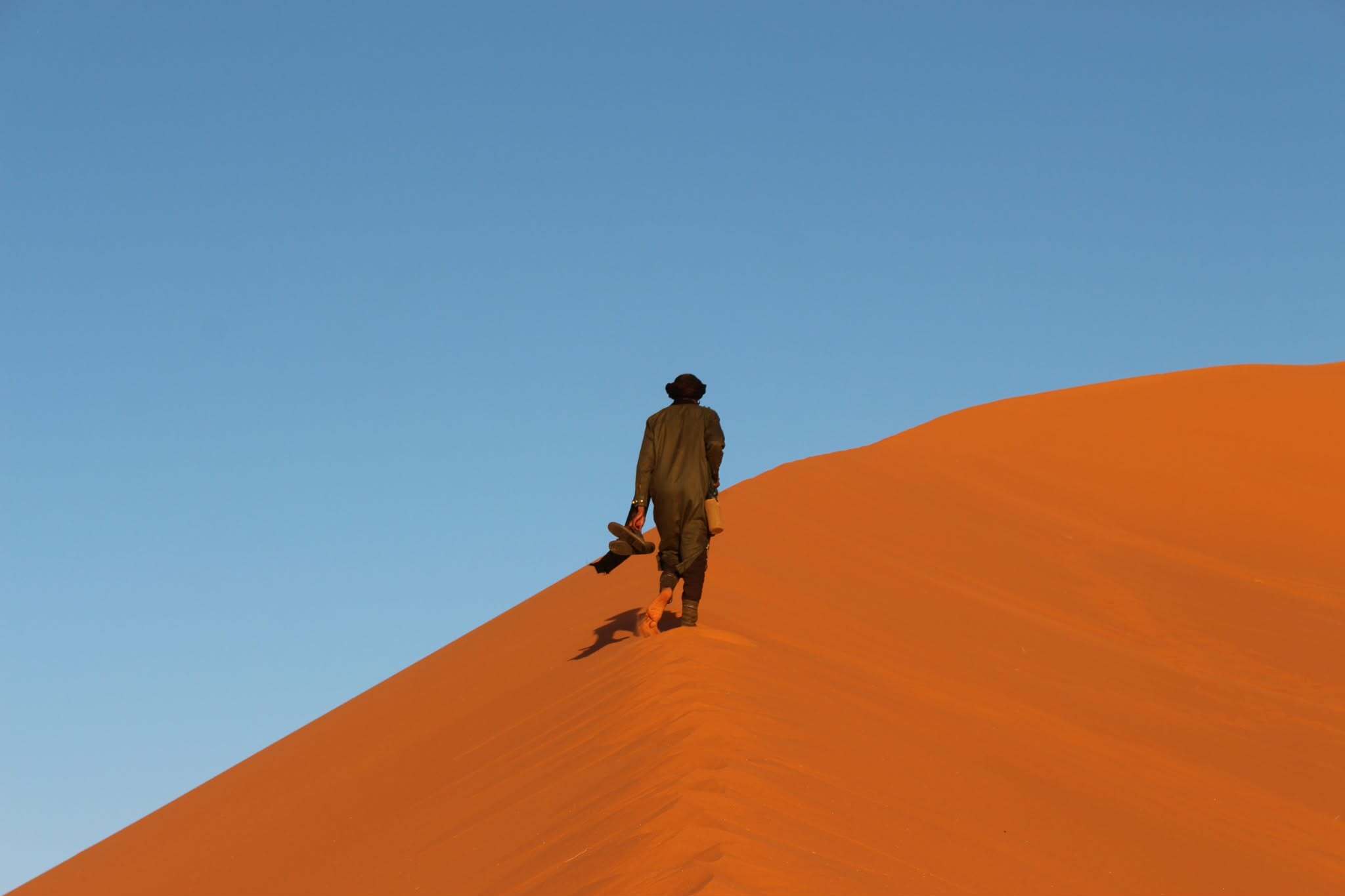
Walking among the Tuareg goes far beyond the simple act of moving from one point to another. In the desert, walking becomes
a fundamental practice, a means of survival, but also a profound spiritual act that unites the body, mind, and nature.
It embodies a form of inner quest and communion with the environment, where each step is a moment
of listening to and connecting with the elements.

Nomadism, a way of life rooted in walking

The Tuareg are a nomadic people who have lived for centuries in the vast expanses of the Sahara. Nomadism is a way of life and movement in harmony with an environment as vast as it is challenging. Walking is essential to their daily lives, not only for transportation, but also for carrying out crucial tasks such as finding pasture for livestock, gathering medicinal plants, and, of course, searching for water, a precious and scarce resource in the desert.

For the Tuareg, walking is not just a physical act, but a true spiritual commitment. Every journey across the desert or through the mountains, whether to lead animals to water or to gather medicinal plants, becomes a form of moving meditation. It is in this slowness of movement, in the precision of gestures and observances, that a form of awakening and reconciliation with the universe is achieved.

Walking: a means of subsistence

Walking is not only a spiritual act for the Tuareg, but also a necessity for the community’s survival. Water, pastures for camel herds, and medicinal plants essential elements of nomadic life are not readily available in the desert. This necessitates regular and often long journeys across the Sahara.

The Tuareg know the desert like no one else. They know where to find medicinal plants that heal ailments, remedies passed down from generation to generation. Certain types of plants, such as herbs used to relieve muscle pain or decoctions to treat digestive problems, are gathered during long treks across the desert.

Regular travel across different parts of the Sahara is also necessary for livestock management. The Tuareg, who raise camels, goats, and sheep, must walk long distances to find the best pastures. Animal welfare depends on the community’s ability to move to new grazing lands, often with the changing seasons, to avoid depleting local natural resources. It is a symbiotic relationship, where humans, animals, and nature are interconnected.

Walking as an act of well-being and meditation

Beyond its daily necessity, walking among the Tuareg is also a practice of well-being. In a world where the frenzy of modern life has often replaced moments of calm, the slowness of nomadism invites a form of disconnection, purification, and introspection. Walking in the desert, far from the noise and bustle of cities, allows one to reconnect with body and mind. The desert, with its majestic silence, becomes a place conducive to meditation and inner listening.

Walking in the desert also means immersing oneself in an environment where the elements, sand, wind, heat, and cold play a fundamental role. Walking becomes a way to merge with these elements. This practice is also a means of preserving a sacred connection with the earth, a respectful gesture toward the nature that nourishes and protects.

Walking is much more than just a means of transport. It embodies a way of life, a spiritual act, and a means of subsistence.

It is a practice that connects humanity, nature, and the sacred, and that allows nomads to maintain a balance with themselves and their environment.

Terres Touareg
Privacy Overview

This website uses cookies so that we can provide you with the best user experience possible. Cookie information is stored in your browser and performs functions such as recognising you when you return to our website and helping our team to understand which sections of the website you find most interesting and useful.